

Spa foresight
What’s going to have the biggest impact on spas in the future? Spa Business outlines the trends, technologies and strategies that are coming down the track


Longevity and fitness are two major trends currently disrupting the industry. As interest in these areas has grown, operators and suppliers are getting more creative with their offerings, which has led to the emergence of brain-focused programming.
With operators such as Clinique La Prairie getting in on the action, exciting advancements in this field are already cropping up, including initiatives like Sparkd Fitness’ pioneering brain-body fitness solutions. The brand’s multi-component training modality includes cardiovascular and strength training, coordination and motor-skill training, as well as cognitive motor training or dual-task training. An example might include doing squats while working on maths or memory games on a technology screen.
Recent studies show that dual-tasking – literally doing two things at the same time (which is different from switching your attention from one stimuli to another) increases neuroplasticity, which in turn yields brain health benefits. The process optimises longevity and brain-body performance, helping people be fit for life and primed for success. As awareness grows, we anticipate an increasing number of wellness facilities will enhance their offerings by integrating brain-training experiences and workouts.

Back in the days before music streaming services, listening to music was a more active activity; you’d put a vinyl album on and just listen. The order of the songs were important – the album might even tell a story of sorts. Today, that kind of deep listening is something of a lost art (though Gen Z is discovering analogue systems like vinyl records and bringing them back). But it’s a kind of mindful practice, with aspects that could dovetail nicely with wellness programming.
At Farris Bad in Norway, development manager Lasse Eriksen has started a programme of Deep Sauna Listening, where guests listen to complete albums from classic artists like The Doors, Pink Floyd, Miles Davis and even Mozart and Beethoven – all while in the sauna. “Deep listening means paying full attention to the music, understanding the emotions, intentions and stories behind it, and being fully present in the moment,” he explains. “Music is also a powerful tool for healing and connection.”
Sauna and deep listening are a perfect match, says Eriksen, because both help you to be present and free your mind from distractions. The response to the sessions has been “overwhelmingly positive,” he says; each session can accommodate around 40 people, and they’ve all been fully booked. “Participants often describe the sessions as transformative, feeling deeply connected to the music and their own emotions,” he says. “The emotional impact of the music, combined with the immersive sauna environment, provides a powerful, memorable experience.”
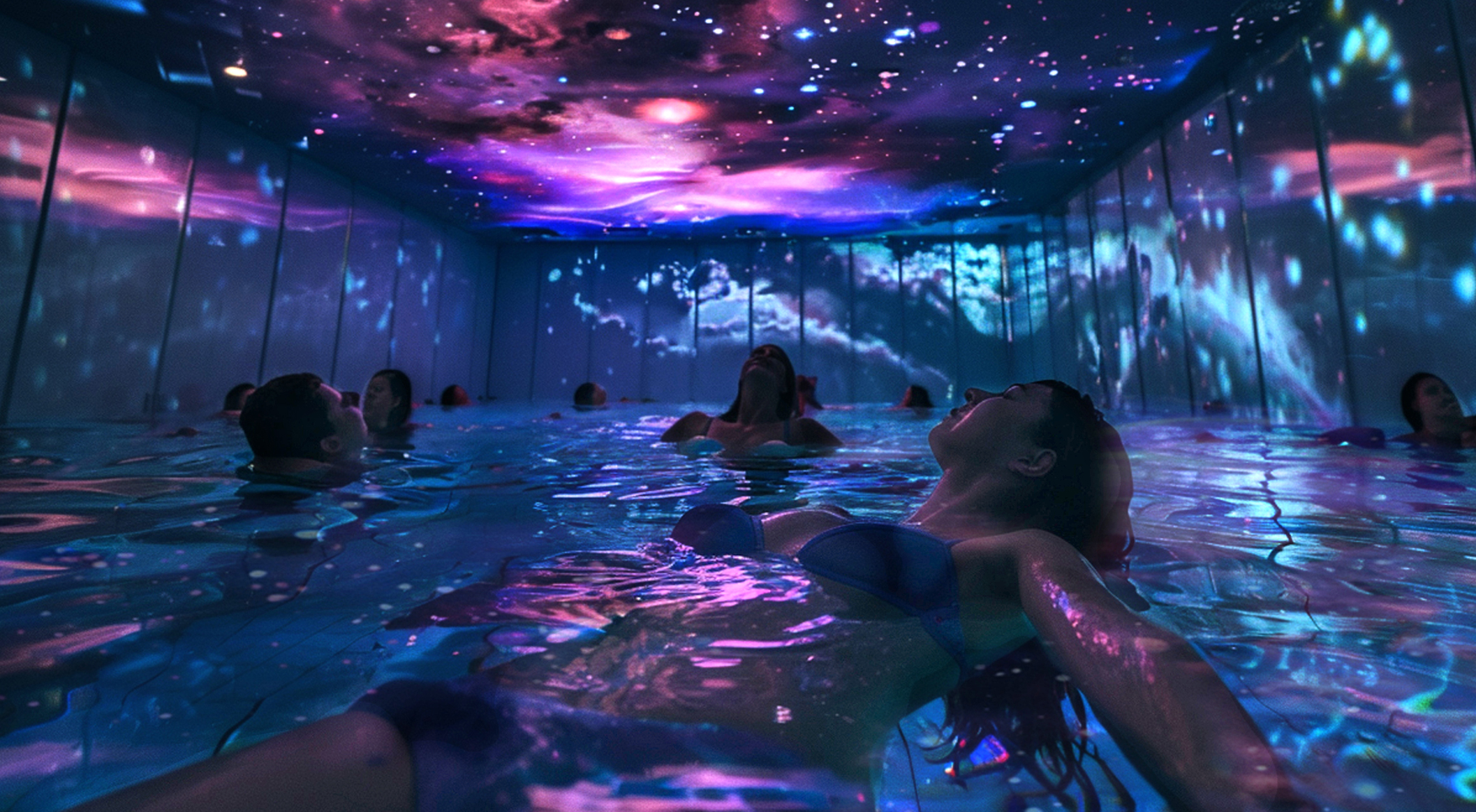
Meanwhile, at Peninsula Hot Springs in Australia, a Sound Dome has been installed to add to the regular programme of music and wellness. The geodesic dome is designed for multi-sensory experiences as well as music performances. Peninsula also showcases performances in its outdoor amphitheatre and uses underwater speakers in hot springs pools, so that guests can lie in the pools listen to music and look up at the stars.
And at Submersive – a 25,000sq ft (2,323sq m) wellness facility set to open in Austin, Texas, US in 2026 – deep listening will form an integral part of the immersive art bathhouse, with underwater sounds played in sequence with images, all scientifically developed to transport guests into an elevated state of consciousness. “Our goal is to amass the world’s deepest understanding of how multisensory experiences affect us on a physiological level,” says Corvas Brinkerhoff, Submersive’s founder, who plans 11 more locations worldwide after Austin.
The wellness world has gone crazy for all things cold: ice baths, contrast therapy, cryotherapy. At the same time, there’s been an explosion of social wellness facilities – modern bathhouses, hot springs and other settings that bring people together and let them socialise.
But what happens when these two trends collide? Art of Cryo – whose cryotherapy systems already accommodate up to four people – has recently introduced its largest unit yet in Madeira, Portugal, which can accommodate 20 people at one time. Additionally, the MCS Experience Tunnel – which includes 12 stations for guests to do in pairs before their cryo session, including far infrared, LED light therapy and aromatherapy – essentially turns the entire experience into a social event for groups of friends, colleagues or even sports teams. The company plans multiple locations during the next few years.

Historically, in many spa towns, people didn’t just bathe in thermal and mineral waters – they also drank them as part of their cure. In many of these historic thermal towns – from Karlovy Vary in the Czech Republic to Bath, England – you can still taste the mineral waters, which often flow from a historic fountain.
“The taste of water transcends a mere sensation,” says water sommelier Milin Patel in an article written for Therme Group. “It’s a symphony of flavours and textures orchestrated by the minerals it carries. As we savour these unique mineral profiles, a remarkable reaction takes place within our brains. This intricate relationship between minerals, sensory experiences, and the brain’s yearning for more provides us with a profound appreciation of the water we consume and its impact on our overall wellbeing.”
With so many new hot springs resorts in development, we see a new opportunity for mineral water tastings. Even in spas without their own mineral water source, hosting water tastings can provide a mindful experience and a healthy alternative to things like wine or spirit tastings.
“How can we truly value something if we lack a vocabulary to describe it?” asks Patel. “It’s time to change that. Let’s establish a language to articulate the taste, mouthfeel, and nuances of water, just as we do for other beverages we value. We must elevate the drinking water experience.”
We couldn’t agree more.

We’ve all heard the statistics about the ways that teenage mental health is declining – social media, a once-in-a-generation pandemic, global warming and an unstable political climate have all contributed. An analysis of 29 studies – which included 80,000 young people from across the globe – published between 2020 and 2021 found that 20.5 per cent had significant anxiety. The statistics are decidedly worse among girls and LGBTQ+ youth. In the US, a survey from the Centers for Disease Control found that almost 60 per cent of female students and close to 70 per cent of LGBTQ+ students had experienced persistent feelings of sadness or hopelessness during the past year.
We are in the wellness industry – and increasingly, our industry is focused on mental wellness in addition to physical and spiritual wellness. We expect the growing crisis to change this situation and for operators to increasingly skill-up to welcome and support younger teens to help them improve and maintain both their mental and physical health.
At the Global Wellness Summit in Miami last year, Amy McDonald, owner and CEO of Under a Tree Consultancy, raised this issue on a panel focused on the wellbeing of our children. A mother of a teenage daughter herself, McDonald pointed out that so many spa and wellness centres have outdated policies on age limits.
“If spas can reach out and bring something as simple as mindfulness to teens and teach them about gratitude – those are powerful tools,” she said. “Our industry has catered to 25- to 65-year-olds really well, but that younger group really needs us.”
Some spas and wellness destinations are welcoming people of all ages, such as Zulal Wellness Resort in Qatar, which has a dedicated area for families.
In the UK, a three-day Rewire Retreat was held in Somerset last year. Aimed at girls aged 14 to 16, the retreat was designed to teach them how to regulate their emotions and develop a strong sense of self in an increasingly digitalised world. Using somatic practices like sound baths, yoga, meditation and breathwork, combined with foraging, campfires and wild walks, the intention was to “equip the participants to return to their lives feeling self-reliant and grounded.”
Others are taking note too – Yale’s popular Psychology of Happiness course has been retooled for teens, teaching them how to manage stress and engage in evidence-based behaviours that are proven to boost mood.

We believe the use of virtual reality, mixed reality and other immersive technologies by consumers in the health and fitness sector will take a leap forward with the development and adoption of gesture-tech.
One example of this emerging technology is the recently launched Mudra Band for Apple Watch. This ‘watch band replacement’ uses Surface Nerve Conductance sensors to capture neural signals that are transmitted to the brain from a user’s wrist and finger movements. These are then used to control Apple devices using simple ‘air touch’ hand and finger gestures.
Gesture-tech will redefine how humans interact with technology, eliminating the need for physical contact and making the experience more fluid and intuitive, while also enhancing the use of virtual and mixed-reality applications and bringing a new dimension to fitness offerings.

While skincare has boomed in popularity since the pandemic, it appears haircare is set for a similar trajectory, with consumers investing in enhancing their hair health and developing a dedicated haircare routine.
Market insiders have dubbed this trend as the ‘skinification’ of haircare, reflecting the shift in consumer behaviour towards treating hair with the same meticulous care as their skin. This involves adopting a multifaceted routine that extends beyond traditional shampoo and conditioner, incorporating products including scrubs, creams, masks, essences, serums, sprays, specialised massage tools and more.
This upturn has led to the emergence of specialised ‘headspas’, generating significant buzz across TikTok and Instagram. Treatments typically encompass a thorough hair and scalp analysis, head massages, steam cleanses, hair masks and the use of specialised shower heads designed to deeply cleanse the scalp and neck.
Recognising the escalating demand, established industry players are seizing the opportunity to tap into this trend. For instance, Rosewood has opened its Hair Wellth Spa in collaboration with Claudia di Paolo in Madrid, Spain. Moreover, this upturn in recent years has also sparked the emergence of new hair wellness brands including Flora Lab Paris and Monpure.
Given that many consumers gravitating towards this trend are already well-versed in skincare practices and are likely avid patrons of spas, it presents a lucrative opportunity for wellness facilities to capitalise on this burgeoning market. Hair treatments seamlessly integrate as complementary add-ons to existing treatment menus, while the surge in demand for haircare products underscores the potential for retail expansion.

Wild wellness is experiencing a surge as consumers seek transformative experiences that allow them to authentically connect with their raw emotions. These experiences foster both physical and mental wellbeing and are aiding in the healing process of lingering pandemic-induced trauma.
Scream therapy, now offered at Armathwaite Hall Hotel & Spa in the UK, is just one example. Its aim is to provide individuals with a cathartic outlet to release pent-up emotions and alleviate stress by engaging in resounding screams within a therapeutic environment. According to spa manager Lorela Movileano, the 400-acre private woodland surrounding the hotel has been curated into a haven where guests can unapologetically express their emotions.
Indonesia has also begun to embrace this trend, sometimes referring to it as catharsis therapy, which may involve screaming, crying or rage room therapy.
Movement-based forms of liberated wellness are also gaining in popularity, with transformative workout and wellbeing practice Sanctum capturing the world’s imagination. Founded in Amsterdam during the pandemic, Sanctum merges elements of HIIT with kundalini yoga, martial arts, animalistic flow, breathwork and primal fitness. By marrying Eastern wellbeing practices with Western fitness methods, Sanctum aims to instil a sense of purpose and reconnection to physical activity. It now has partnerships with Six Senses and Auberge, and plans to expand its reach to the US, Italy and Switzerland.
This emphasis on liberated wellness signifies a shift in consumer mindset, where the focus is not solely on feeling good, but also on embracing the journey – regardless of appearance.

With 2023 having gone down as the hottest year on record and with devastating fires in places from Greece to Hawaii, many people are rethinking traditional summer beach holidays and instead flocking to cooler climates. Digital travel platform Booking.com found that 43 per cent of UK travellers are looking at cooler destinations in 2024, while luxury travel network Virtuoso reports an astounding 82 per cent of its clients are looking at locations with more moderate weather.
This is a trend that will only continue as the planet continues to warm; analysis from The Washington Post and CarbonPlan shows that by 2050, more than five billion people will be exposed to at least a month of extreme heat each year.
Spa Business first reported on Arctic tourism and spas back in 2019, when tourism numbers in Iceland had quadrupled and numbers of travellers north of the 66th parallel had reached 10 million and were rising steadily. Places like Scandinavia, Canada, Iceland and the Baltic are also emerging as alternative destinations for summer travel, while those who aren’t tied to school holidays are shifting dates for visiting traditional hot spots like Greece, Spain and Italy. Meanwhile, spa resorts in destinations such as Arizona or Morocco are looking at creative ways to introduce nighttime programming to keep guests out of the heat (see page 24). The growing trend in cold spa therapies, wild swimming and extreme bathing works well with this trend towards coolcationing, and we predict these cold therapies will continue to increase in popularity.

As momentum behind Oman Vision 2040 – a national reference for economic and social planning for the country – picks up pace, we predict a surge in hospitality, spa and wellness projects in the near future, much like the mind-blowing giga projects which are already coming to fruition in Saudi Arabia.
The drive behind the initiative is to create a “developed, diversified and sustainable national economy” in Oman, which has historically relied on oil as its main industry. His Majesty Sultan Haitham Bin Tarik has revealed that part of its ambition is to attract US$51 billion (€46.9 billion, £40.1 billion) in tourism investments in the next 16 years.
The recently announced US$4.2 billion (€3.87 billion, £3.3 billion) Omani Mountain Destination on Jabal al Akhdar is a prime example of the type of project we expect to see more of. The high-altitude mixed-used development has been master-planned by AtkinsRéalis and is based on its Seed approach, which focuses on environmental, cultural and social wellbeing. It will include 2,527 residences, 2,000 hotel rooms and a health and wellness village called The Vessel. It will also feature a biodiversity hub for both local and international research, dedicated wellness zones, a high-altitude sports hub, amphitheatres, a museum and green spaces.

The most basic of wellness modalities, walking is accessible to nearly everyone without mobility issues. Whether you’re old or young, in shape or not, walking is a simple tool to put movement in your life, which can help improve mood, reduce symptoms of anxiety and depression, and promote creativity. The ancient Greeks understood this, hosting walking meetings and lectures to optimise brain function. Today, in our ever more sedentary and screen-focused society, walking can be a useful tool not only for incorporating movement, but also for mental decluttering and switching off – and most often, it’s free and accessible.
That’s not to say there’s not a business strategy around walking; look no further than The Ranch, the successful US wellness resort that’s built an entire programme around walking – at a cost of more than US$10,000 (€9,300, £7,845) a week. Guests walk for 4-5 hours a day, eat a limited-calorie menu that’s vegan, gluten-free, alcohol-free and caffeine-free, and spend the afternoons partaking in yoga, strength training and massages.
At the UK’s South Lodge, a new “Walk Yourself Happy” two-day wellness retreat this September combines cold-water swimming, breathwork, Wildfitness, journaling and walking in the Sussex countryside, priced at £1,650 (US$2,100, €1,958) per person.
Also in the UK, Armathwaite Hall has introduced guided group Silent Estate Nature Walks – priced at £75 (US$95, €89) – to its wellness offering, capitalising on the silent walking trend sweeping social media. Essentially a form of forest bathing or moving meditation, silent walking invites people to switch off and be mindful, focusing on sensory elements like smell, touch and hearing.
Walking and spas go hand-in-hand, and being set in the countryside is not a prerequisite. In the early European spa towns, the landscape that surrounded the town was seen as incredibly important to the overall sense of wellbeing, with most incorporating a planned promenade to walk along – and to see and be seen.
Any spa, hotel or wellness centre can incorporate walking into its wellness programming – usually at little cost. Guided hikes, suggested trails, or even silent walking through a city park can all bring a sense of calm and peace to guests and reshape the way they connect with their surroundings.

With technology making it possible to convert the electrical impulses and frequencies from vegetation and minerals into healing soundscapes, we predict that the use of plants in spas will become so much more than just for decorative purposes. Inventor Justin Wiggan is leading the way in this arena; he composes soundscapes from plant, tree, rock and crystal energy – a process known as bio-sonification. His work has already caught the attention of several spa leaders, including operator Six Senses and consultants Bonnie Baker and Diana Mestre.
He’s working with them to realise sound art-based wellness initiatives, and suggests that bio-sonification equipment could be set up in spa gardens and interactive living bio walls indoors, or in any rooms with plants and crystals, so guests can immerse themselves in the experience.
People who’ve experienced Wiggan’s quirky plant bio-sonifcation pop-ups report big emotional and physical changes. In addition, a recent study of his work by the UK’s University of Plymouth indicated a positive effect on blood pressure and stress levels.
Most recently, Wiggan has teamed up with music provider Myndstream in a ‘Skydentities’ project, which sees them using cloud-scanning technology to generate music based on clouds’ energy. He says he’s also looking to create “immersive sonic wellbeing spaces” using sun, moon and starlight as sources, as well as fire. On top of this, Wiggan is developing a haptic suit, which translates plant energy into vibrations to massage people.

With so many studies showing the benefits of regular meditation, it’s no wonder that people are interested in the practice. But often, meditation can be difficult; it’s hard to sit still and the mind easily wanders.
Binaural beats – which are essentially two different tones with different frequencies, each of which is heard through one ear via headphones – are said to produce the same brain state as meditation, but much faster and in a more passive way. Listening to binaural beats creates something of an auditory illusion and tricks your brain into processing the difference in the tones. Benefits can include reduced anxiety, an increase in focus, lowered stress, a boost in creativity and even pain management.
Increasingly, the technology is being used in spa equipment, such as Gharieni’s Welnamis and the Somadome. As research continues, we predict we’ll see more of this in spa treatments.

Wearable tech and other diagnostic devices are already having a huge impact on the prescription of highly personalised healing programmes in spas. As these tools become more sophisticated, we see them filling a gap in the market for a real-time biofeedback portal. We foresee a time when such a portal will be a staple in spa receptions – visitors will walk through it and have their vitals scanned and then, based on those results, will instantly be advised on a range of health and wellness modalities to immediately enhance their wellbeing. Perhaps their stress levels are too high, so they need to meditate; maybe they’ve had too many carbs to eat so it will suggest a more nutritious, balanced meal that the spa can prepare.
The same portal could rescan spa-goers when they leave – as evidence of the benefits of the services – and print recommendations for when to revisit and for what, backed up by an at-home programme.

Spa and wellness development is set to boom in Bhutan, following a recent announcement by King Jigme Khesar Namgyel Wangchuck that he’s creating a mindfulness city nearly as big as Hong Kong in Gelephu – a small town in the south.
The spiritual country has staunchly protected its borders for decades, severely restricting tourism, and it’s known as a closed economy with very little foreign investment. However, the goal of Gelephu is to create an economic hub and a trading corridor linking it to northeast India and, beyond that, Myanmar, Thailand, Cambodia, Laos, Vietnam, Malaysia and Singapore.
It will operate as a special administrative region, giving it legal independence and autonomy to formulate laws, policies and incentives to provide a conducive business environment and attract foreign investment.
The development will be underpinned by Bhutan’s deep-rooted spirituality and its Gross National Happiness index – a measure based on the wellness of people that guides the government of Bhutan, alongside Gross Domestic Product.
“I became king at 26 and now I’m 43 years old. I’ll do everything in my power to realise this [mindfulness city] vision,” said the monarch. “Gelephu will become a gateway connecting Bhutan to the world and the future.”
Star architect firm Bjarke Ingels Group is behind the master plan and it reveals that alongside major improvements in infrastructure – including the construction of an airport – offices, residences, hospitals and eventually world-class hotels and spas will be built. The latter is likely to draw on Bhutanese wellness practices such as meditation, hot stone baths incorporating ‘menchu’ (medicinal spring water) and ‘sowa rigpa’, traditional Tibetan medicine based on herbs and minerals and modalities such as acupuncture and moxibustion.

While many wellness clubs and fitness centres are largely concerned with delivering strength training, group exercise, cardio and now recovery and Reformer Pilates, we expect a market to emerge for body-sculpting exercise.
Modalities that exercise the micro-muscles – also called the accessory muscles – have been around for many decades and been delivered by specialist studios, but their power to change body shape, create greater flexibility and improve power, function and balance makes them attractive to today’s consumers.
Wellness club Surrenne at The Emory in London has partnered with specialist Tracy Anderson, whose Method has transformed the physiques of Hollywood actors. Anderson’s studio at Surrenne offers muscular structure choreography, dance cardio classes, and the Tracy Anderson Mymode programme and apparatus, as well as Anderson’s patented Super-G floor and isokinetic band system.

As global temperatures increase, billions of people are being exposed to heat and humidity so extreme it’s life threatening. As a result, we expect people in some parts of the world to become nocturnal as they adapt to these living conditions and for spas to accommodate these trends with things such as 24/7 operations, special cooling rooms and Vitamin D lamps.
With the push to reduce carbon emissions, building designs will also need to be adapted to reduce reliance on conventional air conditioning, with solar battery powered fans and night air capture systems, as well as moving water being used to cool spaces.
Research undertaken by the Penn State College of Health and Human Development found large parts of the planet – including China, India and Pakistan – are likely to experience ‘unsurvivable’ heatwaves in the near future – humans can cope with temperatures over 50°C if there is low humidity, but anything over 35°C with high humidity is unsurvivable, as there is no way to cool by sweating.
When global temperatures hit 2°C above pre-industrial levels, four billion people in India, China and Africa will experience many hours of heat each year that surpasses human tolerance. At 3°C above, this effect will impact the US – from Florida to New York and Houston to Chicago – as well as South America and Australia. At 4°C, parts of Yemen will get 300 days of unsurvivable heat a year. All nations will be impacted to a degree and people will need to adapt to survive.

There’s a natural connection between art and spas, so it’s surprising we haven’t seen more of it. Looking at art requires a slowing down of sorts, and a spa relaxation room could be a perfect alternative to an art gallery. According to international art consultants Artelier, “going to the spa ought to transport the visitor far from their everyday life, to a place of tranquillity and rejuvenation. Specially commissioned art for spas creates an immersive experience like no other.” Artelier works to “spa-proof” art objects, using special humidity-resistant coatings on sculptures or commissioning artists to create hand-carved wooden panels for sauna art.
At the N Le Spa at the iconic 110-year-old Le Negresco hotel in Nice, France, international spa consultant Patrick Saussay took inspiration from the hotel’s 6,000-piece art collection when the spa was revamped this year. Each customer is encouraged to spend time strolling around the hotel, contemplating sculptures and artworks from its collection, before finally winding down in the spa, which is also home to an immersive yoga experience where sound and movement are brought together with digital art.
Social bathing giant Therme Group runs an entire specialist initiative called Therme Art, which organises immersive art experiences at its facilities, working with contemporary artists to create art for wellbeing.
In 2021, global art collective teamLab recognised the meditative state that spas can bring and how that pairs well with art. An immersive exhibition in Tokyo invited guests to view mesmerising artworks while in a “sauna trance”, brought on by contrast bathing cycles. TeamLab said sauna trance – which is brought on by the transition of dominance from the sympathetic nervous system to the parasympathetic nervous system – “sharpens the senses, clears the mind and allows the beauty of the surrounding world to come into focus. Meaning what normally goes unnoticed can be experienced.” The exhibition included a sauna area, cold bathing space and an art submersion area.
We think there’s room for more programming like this, as both spas and art naturally invite people to slow down, reflect and take time for things they might normally be too busy for.

Globally, around 15 million people will have a stroke in the next 12 months. Five million will die, five million will recover and the other five million will be left permanently impacted, with life-changing disabilities. Just as swift medical treatment following a stroke can substantially improve the outcome, so can rehabilitation, when delivered in a timely way, help the brain heal and enable people to avoid long-term disability.
New guidelines lay out clinical best practice for stroke recovery. The National Clinical Guidance for Stroke, published in the UK, recommends six hours of activity a day, to include exercise.
The spa and wellness industry is well-placed to address this challenge. At the University of Strathclyde in the UK, VR treadmills, power-assisted equipment, balance trainers and upper-limb training systems are used to assist in stroke recovery, and we expect the sector could deepen its commitment to delivering stroke interventions.

Everyone with a pelvis has pelvic floor muscles, which are located between the pubic bone and the tailbone and support the bladder, urethra, bowel, rectum and anus, as well as the vagina and uterus in females and the prostate in males. If you have a healthy pelvic floor, you should be able to contract, squeeze, lift and relax those muscles, but the prevalence of pelvic health dysfunction is more common than people think. Estimates are that more than 50 per cent of women suffer from pelvic health issues, and most have never sought help for it.
Pelvic health affects both women and men, but in different ways. “Men are more likely to experience pelvic floor dysfunction due to tension and tightness in the pelvic floor, which can lead to pain, poor bladder control, constipation and erectile dysfunction,” says Leanne O’Brien, lead pelvic health physiotherapist for UK-based Ten Health & Fitness. “Women typically suffer from weakness caused by lifestyle changes, such as pregnancy and menopause.”
Menopause in particular can cause problems, as oestrogen levels drop. “Many midlife women are mortified to find they wet themselves while exercising,” says Baz Moffat, co-founder of The Well HQ, who has partnered with The Gym Group to train PTs in pelvic health so they can deliver workshops.
Spa and wellness centres, too, could get involved. One idea is to partner with a women’s health physio to run classes or workshops, taking pelvic health to a new level. Many of the modalities that spas or wellness centres offer – such as yoga, pilates or even breathwork – already incorporate exercises that help with pelvic floor health.
“My hope and belief is that by talking about pelvic floors and adapting exercises, we can stop women feeling ashamed and isolated, help them with their issues and encourage them to be active,” says Moffat.


Contract Sales Manager
Membership Advisor
Recreation Assistant/Lifeguard (NPLQ required)
Team Leader
General Manager
General Manager
Swim Manager
Sports Coach
Sports Coach


Swim Teacher
Party Leader
Group Exercise Instructor - Aqua
Swim Teacher
Swim Teacher
Activity and Wellbeing Instructor
Operations Manager - Brentwood School Enterprises
Swim Teacher
GP Exercise Referral Instructor
Duty Manager



Company profile
Directory
Featured Supplier
Property & Tenders
Company: Lee Valley Regional Park Authority
Company: Newmark
Company: EiA Real Estate
Company: Savills
Company: University of Oxford