




Talking point: Should professional football matches only be played on grass?


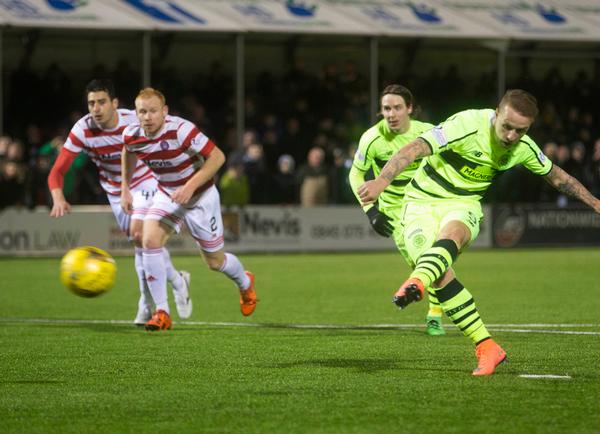
The Professional Footballers’ Association Scotland (PFAS) has questioned the use of artificial surfaces in Scottish league games after 73 per cent of professional players said they’d prefer to play on a “deteriorating grass pitch” than a 3G one.
According to the PFAS’ 3G Pro-Player Survey – which questioned 700 players – the fear of injury and inconsistencies in pitch quality were the players’ main concerns for the use of artificial surfaces.
In response, the Scottish Football Association issued a statement saying there was no evidence suggesting artificial turf caused more injuries than natural grass – and that of the 11 stadiums with artificial surfaces in Scotland, nine have either been installed or upgraded since 2012. We asked the experts for their views.
John Hughes,
Manager,
Inverness Caledonian Thistle

At first I was all for installing artificial pitches at football stadiums, as there’s another economic side to them – which I can totally understand in terms of the local community and academies and the finance. But now I think we should all be playing on grass.
It’s not great for football unless it’s wet. The surfaces can become sticky and create extra bounce. Players simply aren’t happy with it.
If they go in for a slide tackle and if it’s not wet, players can get burnt. I believe it’s not conducive to football.
In terms of it being in the top flight in the Scottish Professional Football League, it’s not for me.
I would make every club pay a bond, let’s say £50,000. If your pitch meets the criteria right through the season, you get your money back.
If you put that bond in place, everybody would look after their pitch and it would be a lot better to play football in Scotland.
"Players are not happy with artificial pitches. They’re not conducive to football"
Professor Jan Ekstrand,
Vice-chair,
UEFA medical committee

The reality is that artificial football turf is not very popular among elite coaches and players. This is probably based on the bad experiences they had in the early days of artificial turf, but there is no scientific substance behind it. Perception is one thing and reality is another thing.
We carried out a study on top teams which played all of their home matches on artificial turf and their away matches on natural grass in order to compare the incidence of injury on both surfaces.
The results of all of the studies – the ones we carried out on elite football but also other studies on amateur and youth football as well as in other regions, such as America – are all entirely consistent: the total risk of injury is the same on football turf as it is on natural grass.
We see the same result in all studies: there is no increase in injuries when playing on FIFA-certified football turf. Some studies show a small difference in the injury pattern, with an increase in ankle ligament injuries on football turf but a decrease in muscle injuries.
I have to say that our studies only focused on injuries that caused absence from either training or matches. There might have been sore muscle or back pain issues that were not part of the studies but that some players and teams have reported.
"The total risk of injury is the same on football turf as it is on natural grass"
Eric O’Donnell,
Managing director,
Sports Labs

In an ideal world, football at all levels would be played on high quality, natural grass pitches which are well maintained. The reality here in Scotland, however, is that neither the weather nor the financial climate is perfect at the moment. 3G artificial playing surfaces therefore have a vital role to play across the game.
Fundamentally, 3G pitches are here to stay and greatly help to ease the burden on grass pitches, which can only be used for football between five to eight hours a week.
Considering that pitch maintenance budgets are continually under threat – given the financial challenges faced by local authorities, who look after the vast majority of public pitches – it is obvious Scotland is faced with real difficulty in supporting its national game in facility terms.”
Developments in pitch technology means 3G pitches are only becoming safer and closer to mirroring the performance characteristics of natural grass. These developments, along with the stringent testing standards in the European Union, make these facilities safe to use.
The impact 3G surfaces have on the development of football is significant – the increase in access, hours of use and the ability to address the climatic challenges of playing football in a country like Scotland are undeniable.
"3G pitches help ease the burden on grass pitches which can only be used for eight hours a week"
Fraser Wishart,
CEO,
Scottish Professional Footballers’ Association

Our survey showed that 73 per cent of players would rather play on a deteriorating grass pitch than an artificial surface. The results of the survey are the opinions of the players, who play and train week in, week out on these surfaces, and they should be taken into account by the clubs and governing bodies when they are looking to introduce artificial surfaces.
There are currently 11 artificial surfaces in the professional game in Scotland, but of these only the two in the Scottish Premiership are subject to random spot checks. Interestingly, 72 per cent of players taking part in the survey said artificial surfaces shouldn’t be allowed at the top level.
No one is claiming players only get injured on artificial surfaces, but more than 70 per cent of those questioned said not only did it take them longer to recover after playing on an artificial pitch, they were also more concerned about picking up an injury when playing on it.
We’re not saying there is no place in the game for artificial surfaces, but it is clear that further discussion is required involving players, managers, surgeons, physios and even groundsmen to determine at what level. We’re simply asking the clubs to listen to the players and the experts when they are making decisions on the future of their playing surfaces.

Duty Manager
Recreation Assistant (Dry Site)
Team Leader (Dry Site)
Community Activator Coach Apprentice
Membership Advisor
Customer Service Advisor
GP Exercise Referral Instructor
Activity and Wellbeing Coordinator
Food & Beverage Assistant



Catalogue Gallery



Company profile
Directory
Featured Supplier
Property & Tenders
Company: Lee Valley Regional Park Authority
Company: Newmark
Company: EiA Real Estate
Company: Savills
Company: University of Oxford