











Lack of diversity in renderings 'doesn't correspond to the real world', says Luxigon founder



Too many visual renderings of future architectural projects “do not correspond at all to the real world” because of a lack of diversity among the people depicted occupying these buildings.
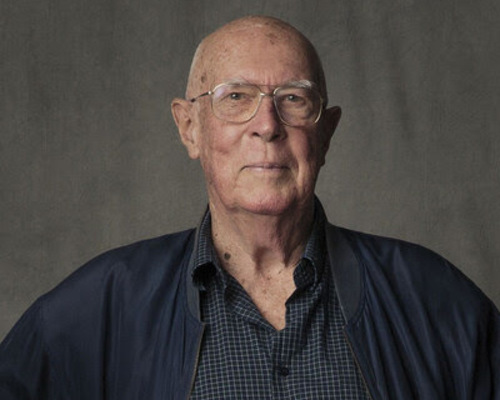
That is the view of Eric de Broches des Combes, the founder of visualisation studio Luxigon, who has told CLAD “there’s sometimes a preconceived idea about who should and shouldn’t appear in renderings from the people who commission the images.”
Illustrators often include people in their renderings in order to offer scale and context to buildings they are presenting. However, campaigners have long argued that these people – predominantly young and Caucasian – are not representative of the multicultural and diverse urban areas they have been positioned in.
“We sometimes receive detailed ethnic demographic proportions to follow – for example 12 per cent black people, 24 per cent Asian people – which I think is stupid,” said des Combes, who has created renderings for many of the world's largest architecture studios and developers.
“We’re also often asked to only include young, healthy people, so that even hospitals are only populated with people who look so good you wouldn’t know they’re ill. There are no fat kids.
"Everybody seems to be ecstatic about being in the building, whatever it is; it could be a power plant. They’re obviously not real people, because they in no way correspond to the living.”
He added that while the demand for images to be true to life is growing, and the technology is in place to make this happen, “it’s up to [the clients] to make it socially realistic.”
He said: “When somebody is telling me ‘don’t put too many black people in the rendering,’ I say, ‘Why the hell would I not put black people in? There are lots of black people living in this area, so let’s represent that. I’m fighting for more diversity, but I’m even fighting to represent the idea that the sky is grey sometimes.
“We had an experience recently with a guy from Beijing who asked us to do extremely realistic images. He said, ‘I want it to be exactly like a real-life picture...except you remove all the fog and the pollution.’ Those battles are the fun of this job. I’m not just here to please the masters.”
In the wide-ranging interview for CLADmag, des Combes also warned that despite even when extremely realistic, “renderings are not a replacement for detailed plans, they just provide an illustration.”
“Architecture is an act of convincing,” he said. “It’s a very political act and visualisations are part of the whole vocabulary. A rendering is a guide, and if it’s used correctly by someone with a conscience, it should be a good way to illustrate their vision.
“The problem is that the people who are looking at drawings know nothing about what goes into architecture. They don’t want to read plans or sections. They just want to see a picture of people wandering around a building with balloons and happy kids. This is where simplification comes from.”
The new issue of CLADmag – our quarterly magazine – is available to read now online and on digital turning pages.
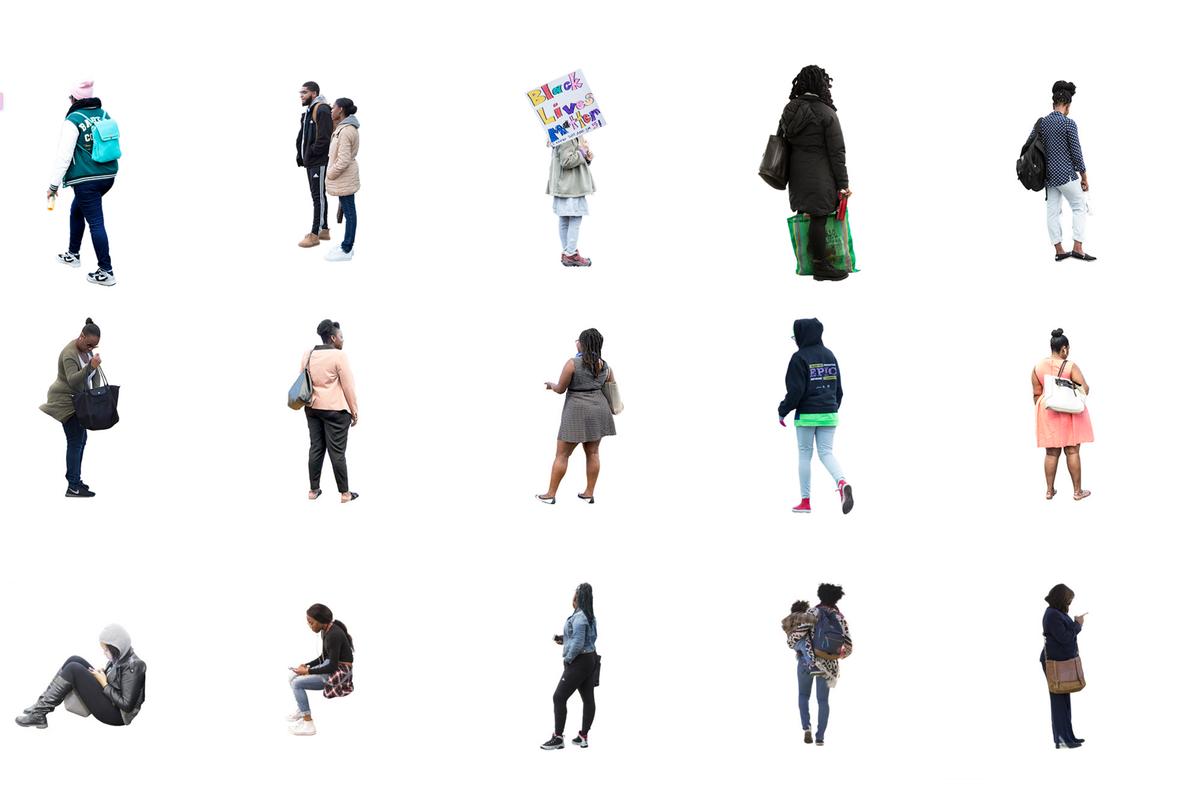
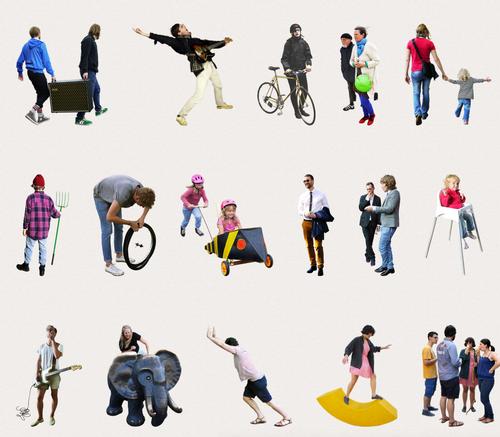
The debate surrounding diversity in renderings has grown in recent years, as online databases of ‘render people’ – cut-out characters who can populate the worlds created by visualisation teams – have become more popular.
The early databases originated in Scandinavia, and as a result the majority of people represented were from nations with predominantly Caucasian populations. According to campaigners, this has limited the diversity represented in renderings.
To counter this, new databases are being established to provide a broader selection of render people. These include Nonscandinavia, Escalalatina and Just Nøt The Same.
Rose Florian and Kordae Henry, creative directors of the latter, have said their mission is to create a digital catalogue of the “misrepresented, under-acknowledged and otherised populations that are so absent in traditional design imagery.”
They argue that as a representation of reality, an image “has the power to inspire us, limit us, lift us and oppress us” and can shape “not only how we see ourselves in the present, but also define the limits of what we can reach in the future.”

Sports Coach
Sports Coach
Swim Teacher
Party Leader
Group Exercise Instructor - Aqua
Membership Advisor
Swim Teacher
Customer Service Advisor
Swim Teacher


Activity and Wellbeing Instructor
Operations Manager - Brentwood School Enterprises
Fitness Manager
Swim Teacher
GP Exercise Referral Instructor
Duty Manager
Community Activator Coach Apprentice

Catalogue Gallery



Company profile

Directory
Featured Supplier

Property & Tenders
Company: Lee Valley Regional Park Authority
Company: Newmark
Company: EiA Real Estate
Company: Savills
Company: University of Oxford