

















Could 'breathable' electronics pave the way for the next generation of wearable tech?


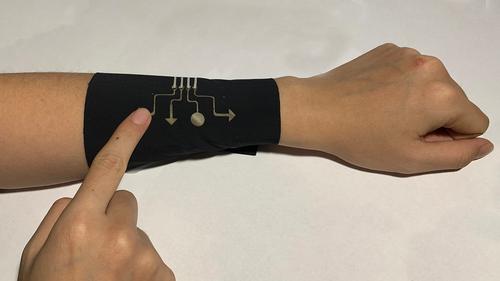
A new ultrathin, stretchable electronic material which allows a product to "breathe" could have the potential to help create more functional wearable tech.
Created by a team of engineering researchers at North Carolina State University (NCSU), the as-yet-unnamed material combines a stretchable polymer film with silver nanowires, making it flexible but highly conductive.
Being gas permeable, the material allows sweat and organic compounds to evaporate away from the skin – making it more comfortable for users, especially for long-term wear.
Designed specifically to be used in wearable tech solutions, the product is extremely thin – only a few micrometers thick – allowing for better contact with the skin and giving the electronics a better "signal-to-noise ratio".
"The resulting film shows an excellent combination of electric conductivity, optical transmittance and water-vapor permeability," said Yong Zhu, professor of mechanical and aerospace engineering at NCSU.
"The gas permeability is the big advance over earlier stretchable electronics – and because the silver nanowires are embedded just below the surface of the polymer, the material also exhibits excellent stability in the presence of sweat and after long-term wear."
To demonstrate the material's potential for use in wearable electronics, the researchers developed and tested prototypes for two representative applications.
The first prototype consisted of skin-mountable, dry electrodes for use as electrophysiologic sensors. These have multiple potential applications, such as measuring electrocardiography (ECG) and electromyography (EMG) signals.
"These sensors were able to record signals with excellent quality, on par with commercially available electrodes," Zhu says.
The second prototype demonstrated textile-integrated touch sensing for human-machine interfaces. The authors used a wearable textile sleeve integrated with the porous electrodes to play computer games, such as Tetris.
"If we want to develop wearable sensors or user interfaces that can be worn for a significant period of time, we need gas-permeable electronic materials," Zhu added. "So this is a significant step forward."
To read a research paper on the new product, click here.





Community Activator Coach Apprentice
Membership Advisor
Customer Service Advisor
GP Exercise Referral Instructor
Swim Manager
Food and Beverage Manager
Activity and Wellbeing Coordinator
Membership Advisor
Food & Beverage Assistant



Catalogue Gallery




Company profile

Directory
Featured Supplier

Property & Tenders
Company: Lee Valley Regional Park Authority
Company: Newmark
Company: EiA Real Estate
Company: Savills
Company: University of Oxford