


The future of wellness
McKinsey’s latest ‘Future of Wellness’ survey finds that consumers are taking greater control over their health — and expect companies to provide effective, science-backed solutions. Anna Pione shares the highlights



From cold plunges to collagen to celery juice, the US$1.8 trillion (€1.7 trillion, £1.4 trillion) global consumer wellness market is no stranger to fads, which can sometimes surface with limited clinical research or credibility. Today, consumers are no longer simply trying out these wellness trends and hoping for the best, but rather asking, “What does the science say?”
McKinsey’s latest ‘Future of Wellness’ research — which surveyed more than 5,000 consumers across China, the UK and the US — examines the trends shaping the consumer wellness landscape. In this article, we look at seven wellness subsets that our research suggests are especially ripe areas for innovation and investment activity.
The science- and data-backed future of wellness
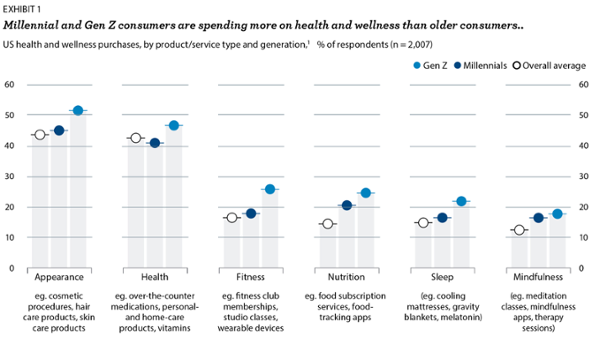
In the US alone, we estimate that the wellness market has reached US$480 billion (€441 billion, £375 billion), growing at 5 to 10 per cent per year. Eighty-two per cent of US consumers now consider wellness a top or important priority in their everyday lives, which is similar to what consumers in the UK and China report (73 per cent and 87 per cent, respectively). This is especially true among Gen Z and millennial consumers, who are now purchasing more wellness products and services than older generations, across the same dimensions we outlined in our previous research: health, sleep, nutrition, fitness, appearance, and mindfulness (Exhibit 1).
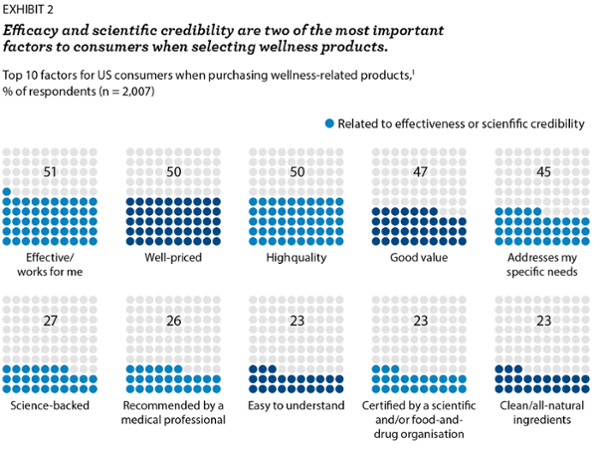
Across the globe, responses to our survey questions revealed a common theme about consumer expectations: consumers want effective, data-driven, science-backed health and wellness solutions (Exhibit 2).
Seven areas of growth in the wellness space
Building upon last year’s research, several pockets of growth in the wellness space are emerging. Increasing consumer interest, technological breakthroughs, product innovation, and an increase in chronic illnesses have catalysed growth in these areas.
Women’s health
Historically, women’s health has been underserved and underfunded. Today, purchases of women’s health products are on the rise across a range of care needs. While the highest percentage of respondents said they purchased menstrual-care and sexual-health products, consumers said they spent the most on menopause and pregnancy-related products in the past year.
Despite recent growth in the women’s health space, there is still unmet demand for products and services. Menopause has been a particularly overlooked segment of the market: only 5 per cent of FemTech start-ups address menopause needs.
Healthy ageing
Demand for products and services that support healthy ageing and longevity is on the rise, propelled by a shift toward preventive medicine, the growth of health technology (such as telemedicine and digital-health monitoring), and advances in research on anti-ageing products.
More than 60 per cent of consumers surveyed considered it “very” or “extremely” important to purchase products or services that help with healthy ageing and longevity. Roughly 70 per cent of consumers in the UK and the US and 85 per cent in China indicated that they have purchased more in this category in the past year than in prior years. These results were similar across age groups, suggesting that the push toward healthy ageing is spurred both by younger generations seeking preventive solutions and older generations seeking to improve their longevity. As populations across developed economies continue to age, we expect there to be an even greater focus globally on healthy ageing.
To succeed in this market, companies can take a holistic approach to healthy-ageing solutions, which includes considerations about mental health and social factors. Bringing products and services to market that anticipate the needs of ageing consumers — instead of emphasising the ageing process to sell these products — will be particularly important. For example, a service that addresses ageing in older adults might focus on one aspect of longevity, such as fitness or nutrition, rather than the process of ageing itself.
Weight management
Weight management is top of mind for consumers in the US, where nearly one in three adults struggles with obesity; 60 per cent of US consumers in our survey said they are currently trying to lose weight.
While exercise is by far the most reported weight management intervention in our survey, more than 50 per cent of US consumers considered prescription medication, including glucagon-like peptide-1 (GLP-1) drugs, to be a “very effective” intervention. Prescription medication is perceived differently elsewhere: less than 30 per cent of UK and China consumers considered weight-loss drugs to be very effective. Given the recency of the GLP-1 weight-loss trend, it is too early to understand how it will affect the broader consumer health and wellness market. Companies should continue to monitor the space as further data emerges on adoption rates and impact across categories.
In-person fitness
Fitness has shifted from a casual interest to a priority for many consumers: around 50 per cent of US gym-goers said that fitness is a core part of their identity. This trend is even stronger among younger consumers — 56 per cent of US Gen Z consumers surveyed considered fitness a “very high priority” (compared with 40 per cent of overall US consumers).
The challenge for fitness businesses will be to retain consumers among an ever-increasing suite of choices. Offering best-in-class facilities, convenient locations and hours, and loyalty and referral programmes are table stakes. Building strong communities and offering experiences such as retreats, as well as services such as nutritional coaching and personalised workout plans (potentially enabled by generative AI), can help top players evolve their value proposition and manage customer acquisition costs.
Gut health
More than 80 per cent of consumers in China, the UK and the US consider gut health to be important, and over 50 per cent anticipate making it a higher priority in the next two to three years.
While probiotic supplements are the most frequently used gut-health products in China and the US, UK consumers opt for probiotic-rich foods such as kimchi, kombucha, or yogurt, as well as over-the-counter medications. About one-third of US consumers, one-third of UK consumers, and half of Chinese consumers said they wish there were more products in the market to support their gut health.
Sexual health
The expanded cultural conversation about sexuality, improvements in sexual education, and growing support for female sexual-health challenges (such as low libido, vaginal dryness, and pain during intercourse) have all contributed to the growth in demand for sexual-health products.
Eighty-seven per cent of US consumers reported having spent the same or more on sexual-health products in the past year than in the year prior. While more businesses began to sell sexual-health products online during the height of the COVID-19 pandemic, a range of retailers — from traditional pharmacies to beauty retailers to department stores — are now adding more sexual-health brands and items to their store shelves. This creates marketing and distribution opportunities for disruptor brands.
Sleep
Despite consistently ranking as the second-highest health and wellness priority for consumers, sleep is also the area where consumers said they have the most unmet needs. In our previous report, 37 per cent of US consumers expressed a desire for additional sleep and mindfulness products and services, such as those that address cognitive functioning, stress and anxiety management. In the year since, little has changed. One of the major challenges in improving sleep is the sheer number of factors that can affect a good night’s sleep, including diet, exercise, caffeination, screen time, stress and other lifestyle factors. As a result, few, if any, tech players and emerging brands in the sleep space have been able to create a compelling ecosystem to improve consumer sleep holistically.Leveraging consumer data to address specific pain points — including inducing sleep, minimising interruptions, easing wakefulness, and improving sleep quality — presents an opportunity for companies.
As consumers take more control over their health outcomes, they’re looking for data-backed, accessible products and services that empower them to do so. Companies that can help them make sense of this data and deliver solutions that are personalised, relevant, and rooted in science will be positioned to succeed.
This article is excerpted from McKinsey’s ‘Future of Wellness’ research.
View full report at: spabusiness.com/FutureofWellness

About the author: Anna Pione is a partner in McKinsey’s New York office.



Swim Teacher
Swim Teacher
Fitness Manager
Operations Manager
Contract Sales Manager
Membership Advisor
Recreation Assistant/Lifeguard (NPLQ required)
Team Leader
General Manager


General Manager
Swim Manager
Sports Coach
Sports Coach
Swim Teacher
Group Exercise Instructor - Aqua
Swim Teacher
Swim Teacher
Activity and Wellbeing Instructor
Swim Teacher
GP Exercise Referral Instructor
Duty Manager

Catalogue Gallery



Company profile

Directory
Featured Supplier

Property & Tenders
Company: Lee Valley Regional Park Authority
Company: Newmark
Company: EiA Real Estate
Company: Savills
Company: University of Oxford