


To inform and inspire
UK Spa Association general manager Bobby Griffiths breaks down the country’s first survey of spa businesses in 18 years



The UK Spa Association (UKSA) is on a mission to take a closer look at the nation’s spa facilities to help owners, operators and managers make more informed decisions about optimising their businesses.
With fresh details for the sector long overdue – figures of the same ilk date back to 2006 – the organisation conducted a State of the Spa Industry Snapshot Survey in June, asking operators to report on customer demographics, the type of treatments and facilities they offer and their workforce.
The findings pinpoint key issues and growth opportunities, painting a promising picture for a sector that’s faced many challenges in recent years. Bobby Griffiths, UKSA’s general manager, analyses the numbers for Spa Business and explains what they mean.
Market demographics
The UKSA’s 2024 State of the Spa Industry Snapshot Survey is based on the responses of 82 properties across the country split between hotel (56 per cent), day (15 per cent), resort (11 per cent), boutique (10 per cent) and destination spas (9 per cent).
Operators estimate that 99 per cent of their guests who have spa treatments are mostly aged between 31 and 55 years old. While the over 55s are from a generation where spas were still very much a luxury rather than a necessity, the lack of business from under 30s is both surprising and concerning. Is the cost-of-living crisis pushing them to enjoy a more modest lifestyle?
Barriers to entry certainly demand a deeper analysis. As spa customers of the future, we must work to understand more about attracting this market segment and how to keep them engaged.
Substantial growth
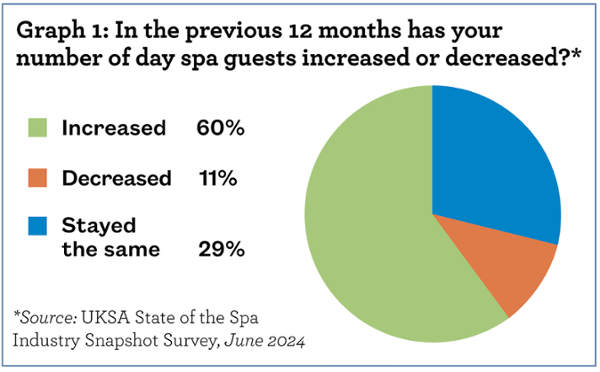
The most significant finding from the survey is that 60 per cent of spas report a growth in day guests over the previous 12 months (see Graph 1). If COVID-19 did anything positive, it was to highlight the need for self-care and help make spa become a more accessible and sociable pastime.
As a result, the value of spa is now becoming obvious and operators are more likely to invest in their facilities further – 37 per cent of those surveyed had upgraded their spas in some way, while 22 per cent had recently had a renovation and 29 per cent were planning one.
While international travel took its time to reboot after the pandemic, staycations and spa days became the norm and people don’t want to give this up. If anything, the figures show these visits are still on the up, with the only threat posed being a shortage of staff to provide the services.
Staffing issue
The lack of therapists coming into the industry is a huge worry and has been for a long time. A career in spas is still not often a popular choice, with many choosing it as an option when they’re unsure what else to pursue. How can we change this perception and market the industry better for the varied opportunities it affords?
Our survey asked if all therapist positions were currently filled. Forty-four per cent of spas said no and 28 per cent of spas said they have at least four or more roles they’re recruiting for (see Graph 2). While 50 per cent of roles had been vacant for less than a month, an alarming 14 per cent of jobs have been available for a year or more (see Graph 3).
Wage watchers
Even once people come into the industry, retention is an issue and one which has worsened since COVID-19, with many therapists choosing to either leave the sector altogether or set up from home, where they can dictate the hours they work. Could UK spas make more of the developmental opportunities available and tap into mentoring to maintain engagement, stimulate motivation and encourage progression?
The next natural question is, is the current therapist wage fair? However, with all business overheads increasing substantially in recent years, there’s a limit to passing costs onto the end user. Wages can also vary hugely by region. The UKSA is keen to delve deeper into this subject and salary and remuneration will form part of a larger State of the Spa Industry survey, which it will conduct next year.
Thinking outside the box
Savvy spas pivot when necessary and without enough therapists to perform treatments, it’s essential to maximise revenue-per-hour. The survey highlights multiple creative approaches operators are adopting:
• Changing to own-branded products to reduce costs (30 per cent)
• Rolling out touchless treatments (45 per cent).
• Incorporating cold therapy (37 per cent) – including ice baths, snow cabins, ice fountains or plunge pools
• Removing short treatments to ensure maximum yield per treatment hour – 28 per cent of respondents no longer offer 30/45-minute treatment protocols and of that group, 87 per cent had done so previously
• Opting out of assistance from third-party booking agents, ensuring maximum profit goes to the bottom line (24 per cent).
UKSA promises annual survey
Anecdotally, spa stakeholders and GMs may have an inkling of some of the insights provided in UKSA’s latest survey. Yet having industry figures to support these notions is essential for the approval of planned strategies and new purchases.
The hunger for UK spa data has been growing for a long time and the reaction to the survey has been humbling. UKSA intends to keep up the momentum and deliver a State of the Spa Industry Survey on an annual basis, in addition to collecting and releasing bite-size snaps of industry data on key issues periodically.
• A full copy of the survey is available for UKSA members – sign up here: https://spa-uk.org/

"28 per cent of spas have at least four or more roles they’re recruiting for" – Bobby Griffiths




Membership Advisor
Sports Coach
Sports Coach
Swim Teacher
Party Leader
Group Exercise Instructor - Aqua
Membership Advisor
Swim Teacher
Swim Teacher


Activity and Wellbeing Instructor
Operations Manager - Brentwood School Enterprises
Swim Teacher
GP Exercise Referral Instructor
Duty Manager




Company profile
Directory
Featured Supplier

Property & Tenders
Company: Lee Valley Regional Park Authority
Company: Newmark
Company: EiA Real Estate
Company: Savills
Company: University of Oxford