








Andrew Frontini – Perkins and Will - tells CLAD the pandemic has exposed weaknesses in the resilience of society


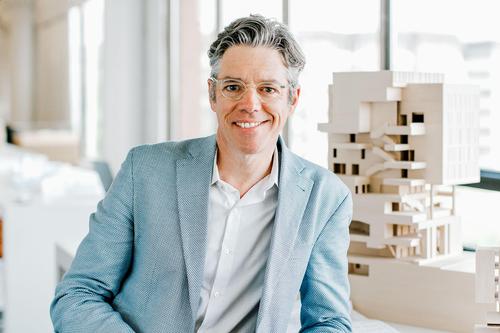
Andrew Frontini, principal and design director of Perkins and Will in Toronto, and his colleague Paul Kulig, principal for urban design and transit, told CLAD how the Covid-19 pandemic will change how we live and move around cities.
There has been a significant trend towards designing health and wellness into the built environment over the last decade, perhaps best illustrated by the launch of the International WELL Building Institute and its WELL Building Standard in 2014.
As Frontini explained, though, the pandemic has exposed weaknesses in the resiliency of society when faced with a major health threat.
"It's struck us by surprise that there's a whole other element to health and wellness in the wake of this virus that is about the density of occupation of space," he said. "The question will be: how can we re-enter the public realm and under what conditions?"
Behavioural change
"Social distancing is now enforced in many countries, but I think it will last as an imprint and we will be inclined to social distance for many months, if not years, to come. At that stage, it will start to shape the city and public spaces – the idea of there being a bubble, a two-metre circle, around everybody. That those circles can't overlap will influence how you line up for coffee, what an escalator is, what an elevator is, what a public staircase is and what a sidewalk is."
While new buildings and spaces can be created with these new requirements in mind, it's simply not feasible to restructure the vast majority of existing spaces to accommodate them. Frontini argued, instead, that we will come to inhabit existing spaces differently.
"There will be a dimensional overlay to all public space that allows us to occupy it at lower density. What that means is that we will have to use the city in a kind of timeshare way, or optimise its utilisation, as opposed to the funnelling in of everyone at a peak hour and falling out of every one at a peak hour."
Adapting uses
Ultimately, such changes to our behaviours and the way we use cities would change how we build them. Kulig illustrated this using the examples of our workplaces and public spaces.
"If we're not commuting to our central offices as frequently – maybe we're only coming in two days a week but we don't have the space in our apartments to to work comfortably – are we going to see the creation of new shared office spaces at a neighbourhood or village scale that allow us to commute 10 minutes up to the top of the street? And then what does that mean as far as freeing up capacity on our transportation system?"
He continued: "Another example that a lot of cities have struggled with is the rebalancing of streets. New York tried for a week, reallocating what I think was about one-and-a-half miles and several blocks of streets for recreation to provide a bit of respite for people that didn't have access to parks, but then pulled it back a week later because they figured they didn't have the police resources to manage it.
"It's about finding the right balance. We are going to see a reduction in mobility or movement into central offices. Does that allow us to reallocate some space on the streets for recreation, transportation and cafés that allow for social distancing?"
New norms
As new norms arise from changing behaviours, Frontini argued the onus will be on designers, urbanists and politicians to ensure they are mapped into the built environment.
"The end-goal from this would be a public realm that could allow business to continue to a much greater degree than it has," Frontini explained. "Could we design or occupy our cities so that we didn't have to shut them down next time this happens?"
Notably, as Kulig went on to explain, we already know that many of the design features or elements that would be required for better promoting health and wellness in the built environment are the same as those required for promoting sustainability and resiliency.
"As an example, providing proper greenways along abandoned land corridors promotes active transportation, reduces chronic conditions like diabetes and similar conditions that are directly linked to lack of mobility, can be used as rain gardens that collect rainwater, manage stormwater impacts, control flooding or mitigate flooding impacts and are also the kinds of places that can have urban gardens, playgrounds, dog parks and provide multiple opportunities for social resilience at a neighbourhood scale."
Living design
This synergy – the recognition that what is good for the environment is typically good for people as well – underpins an overarching approach Frontini referred to as 'living design'.
"The premise is that everything is interconnected," he said. "That energy, energy consumption and resiliency are not separate issues. They're part of a kind of highly-integrated system and you really have to look at humans being part of a continuum of life on the planet."
"What we really hope is that the pandemic can be seen as a symptom of a much larger, integrated problem. It has to do with the way we conduct our business on the planet. When we design cities, when we talk about mobility, when we talk about fabrication and industry, how can we learn from this and do it differently? How can things be adjusted?"

Sports Coach
Sports Coach
Swim Teacher
Party Leader
Group Exercise Instructor - Aqua
Membership Advisor
Swim Teacher
Customer Service Advisor
Swim Teacher


Activity and Wellbeing Instructor
Operations Manager - Brentwood School Enterprises
Fitness Manager
Swim Teacher
GP Exercise Referral Instructor
Duty Manager
Community Activator Coach Apprentice

Catalogue Gallery


Company profile
Directory
Featured Supplier
Property & Tenders
Company: Lee Valley Regional Park Authority
Company: Newmark
Company: EiA Real Estate
Company: Savills
Company: University of Oxford